
Maximize Billable Realization: Eliminate Invoicing Disputes and Leaked Hours with Court-Ready Legal Billing Software

Understanding Legal Billing and Why Accuracy Matters
In simple terms, legal billing is based on billable hours, flat fees, retainers, or contingency arrangements. It doesn’t matter which billing model a firm owns. Either way, time tracking remains the foundation of accurate invoices.
If systems are not set properly, firms risk:
- Underbilling (lost revenue).
- Overbilling (client disputes).
- Issues with compliance.
- Damaged trust by the client.
When legal billing and time tracking software are in place, law firms can remove guesswork and replace it with verified and audit-ready data.
Apart from revenue, accurate billing protects client relationships in the long run. When invoices reflect the actual work performed, clients are likely to understand that the firm is honest and reliable. With billing accuracy remaining consistent, internal evaluations improve, which helps law firms understand which practice areas, types of cases, or clients bring sustainable value over time.
Common Legal Billing Examples in Law Firms
Below are a few billing examples that also assist internal benchmarks for performance evaluation. When time data is reviewed across cases, firms can identify inefficiencies, streamline staff models, and ensure more time is spent on high-value legal work.
- 3 hours on legal research.
- 2 hours drafting motions.
- 1 hour in client meetings.
1. Hourly Billing for Litigation Cases
A litigation attorney may spend:
By adopting legal time tracking software, each activity is logged in real time, defined by case and client, and automatically reflected in invoices.
Automated tracking ensures that every research session, document review, or preparation meeting is accounted for, creating a defensible billing record that meets scrutiny.
- Measuring profitability.
- Prevention of unplanned work.
- Analyzing future pricing strategies.
2. Flat-Fee Billing for Contracts
Flat-fee billing can track time and help firms with:
Accurate tracking ensures flat fees remain sustainable.
Tracking time under flat-fee models also gives historical data that helps law firms clarify future pricing strategies. Over time, firms are clear about how much time each contract takes, which enables competition with profitable fee structures.
- The retainer balance that remains.
- Billable vs non-billable hours.
- Reports on client usage.
3. Retainer-Based Billing
This billing requires specific tracking to ensure client funds are used correctly. A reliable system gives visibility into:
With transparent retainer tracking, clients are reassured that their funds are used responsibly. Furthermore, trust is strengthened by providing them with real-time visibility into billable consumption, which reduces the risk of compliance violations or financial disagreements.
- Improves collaboration and accountability.
- Allows partners to evaluate whether workload distribution is fair.
- Ensures the efforts of junior attorneys are accurately reflected without duplication or oversight.
- Allows partners to assess workload distribution fairly and ensures junior attorneys’ efforts are accurately reflected without duplication or oversight.
4. Multi-Attorney Case Billing
Large cases involve multiple attorneys and paralegals. Centralized visibility into multi-attorney contributions:
Challenges Law Firms Face Without Time Tracking Software
Despite its importance, many firms today still rely on outdated methods of tracking time. Some problems include:
- Time entries are delayed.
- Billing descriptions are inaccurate.
- Invoices are prepared manually.
- Reporting is limited.
- Disputes on client billing.
These challenges lead to operational inefficiencies in the long run. Firms that continue to have delayed invoice cycles, inconsistent cash flow, and exhausted internal processes will make growth difficult without a proper system in place.
How Legal Time Tracking Software Solves These Challenges
When workflow is digitized, law firms gain consistency across teams and locations. This standard method minimizes dependency on individual habits and ensures that firm-wide billing practices are aligned with compliance and client expectations.
Real-Time Time Capture
- Attorneys can log in time as work happens, on a laptop, mobile, or browser. This ensures accuracy.
Additionally, real-time capture reduces the mental burden on attorneys who no longer need to modify their workdays. This leads to more accurate billing entries and fewer unrecorded billable hours.
Automated Billing Accuracy
- Entries are added directly into invoices, which reduces errors and administrative overhead.
When the process is automated, billing descriptions remain consistent and professional, reducing the burden of revising invoices. It quickens billing cycles, helping firms maintain predictable cash flow.
Clear Client Transparency
- With detailed time logs, clients can understand what they are paying for, which reduces internal disputes.
Transparent time records not only justify fees but also demonstrate a firm’s commitment to ethical and professional billing practices.
Compliance and Audit Readiness
- Accurate records support compliance with internal audits.
When time records are well maintained, the firm can provide defensible documentation for audits or disputes. This protects the firm legally while reinforcing compliance with jurisdictional billing regulations.

Why Time Management Is Critical in Legal Work
Effective time management supports an attorney’s well-being. With clear visibility into workloads:
- Burnouts can be prevented.
- Work-life balance has improved.
- Allows leadership to access capacity issues before they impact performance.
Legal professionals juggle deadlines, court appearances, client expectations, and administrative tasks. Poor time management leads to burnout and revenue loss.
Understanding why time management is important in the workplace is important for law firms, where every minute of the day counts.
How ProjecTime by Timeappz Supports Legal Billing
ProjecTime adapts to various flexible legal workflows that allow firms to utilize the software with their processes without changing anything.
ProjecTime by Timeappz is created to support professional service firms, including legal practices, with robust time tracking and billing features.
Key capabilities include:
- Time tracking is based on the case.
- Project and client categorization.
- Invoice process automation.
- Approvals are based on roles.
- Detailed reports for management.
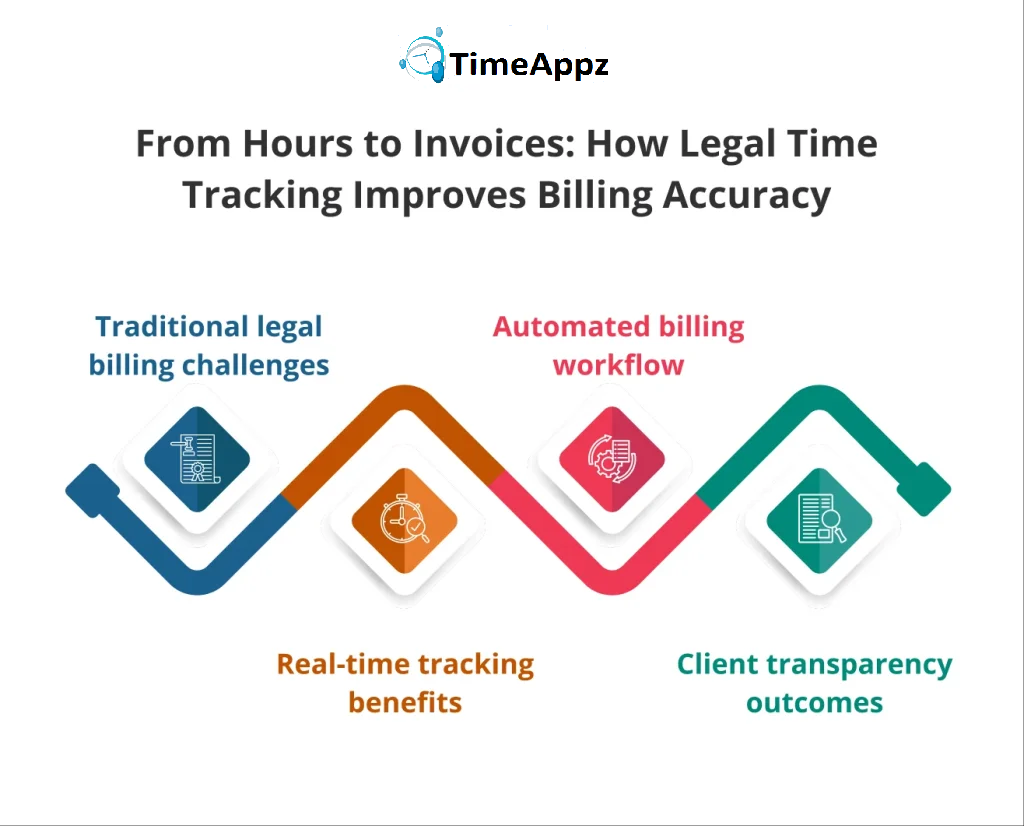
With the following structured workflow, approval delays are less, and the billing process gains consistency across departments. Over time, firms experience a quicker invoice turnaround and improved client satisfaction.
- Attorneys log time by case or client for details.
- Timesheets are reviewed and approved by the manager.
- Time flows are approved into the billing system.
- A detailed invoice is generated.
- The client receives accurate and transparent billing.
This streamlined workflow reduces administrative burden and improves billing accuracy.
Comparison Table: Manual Billing vs Legal Time Tracking Software
| Feature | Manual Billing | Legal Time Tracking Software |
| Time Accuracy | Low | High |
| Billing Errors | Common | Minimal |
| Client Transparency | Limited | Detailed |
| Reporting | Manual | Automated |
| Scalability | Poor | Excellent |
This comparison highlights why manual systems become increasingly unsustainable as firms expand. Digital solutions offer scalability, accuracy, and insight that manual methods cannot match.
Facts and Figures: Why Law Firms Are Adopting Time Tracking
The following statistics reflect a wider industry shift toward data-driven legal operations. Firms that welcome technology early gain a competitive advantage through improved financial visibility and client confidence.
- ABA Journal article highlights billing issues and disputes involving firms. They frequently report this concern as a top client complaint and legal ethics issue.
- The article by Forbes discusses how real companies achieve significant cost reductions through automation.
Benefits of Legal Time Tracking for Different Roles
When the needs of attorneys, managers, and clients are aligned, time tracking software creates a balanced environment where efficiency and fairness can work equally. This strengthens internal operations and external relationships.
Attorneys
- Reduced admin work.
- Billing is accurate.
- The focus is on legal work.
As the administrative burden is reduced, attorneys can focus on delivering quality legal outcomes with accurate billing without extra stress.
Law Firm Managers
- They can forecast revenues for better.
- Metrics show clearly where time was utilized.
- Decision-making has improved.
Managers obtain actionable insights that support fair decisions, profitability, and future planning.
Clients.
- Invoices are transparent.
- Improved trust as billing remains fair.
- Disputes are reduced.
Clients benefit from clarity, predictability, and confidence that reflects actual value delivered.
Why Legal Firms Choose ProjecTime by Timeappz
Its subtle design ensures adoption without resistance, positioning ProjecTime as a productivity tool.
Law firms prefer ProjecTime by Timeappz because it maintains control with flexibility without constant monitoring.
Key factors:
- The interface is user-friendly.
- Billing rules are customized.
- Pricing is scalable.
- Customer support is reliable.
Best Practices for Implementing Legal Time Tracking Software
How well the software is implemented depends on its utilization, leadership support, and reviews. Firms that treat time tracking as a strategic tool (not a billing mechanism) experience maximum profit.
- Attorneys are trained in real-time entries.
- Billing descriptions are standardized.
- Weekly review reports.
- Improve pricing models based on insights.
When implemented correctly, legal time tracking software becomes a growth tool.
The Future of Legal Billing
As the legal industry evolves, they are moving towards:
- Billing is based on outcomes.
- More transparency at work.
- Efficiency driven by technology.
Firms that utilize modern systems today will remain competitive in the future. Those who prioritize transparency and efficiency will take the lead.
Billing driven by technology is no longer an option. It is a competitive necessity.
Conclusion
Accurate billing is essential for a successful law practice. If systems aren’t reliable, firms risk revenue, compliance issues, and exhaust client relationships. By adopting legal time tracking software, law firms can transform billing from a challenge to a strategic advantage.
ProjecTime by Timeappz allows legal professionals to track time accurately, bill transparently, and operate efficiently, without any issues.
When firms utilize modern legal time tracking software, they modify operations, improve finances, and grow sustainably in a competitive legal landscape.
For more information, contact us: [email protected] or Live ChatThe Live Chat option is in the bottom-left corner!← Look Left to explore implementation options tailored to your construction operations.
Frequently Asked Questions
What is legal time tracking software?
- It is software that helps law firms record billable hours accurately by case, client, or task. It ensures transparency and minimizes billing errors.
- It does so by capturing real-time and automating invoice generation. It removes manual errors and misses billable hours.
- Yes. Detailed time logs provide clarity for clients, helping prevent misunderstandings and disputes.
- Definitely. Solutions like ProjecTime by Timeappz work well for both small and large legal practices.
- Yes. Accurate records support audits, regulatory requirements, and internal reviews.
- Yes. ProjecTime by Timeappz integrates seamlessly with billing and payroll workflows.
🎯 Future-Proof Your Firm’s Revenue and Compliance Architecture
Relying on manual spreadsheets or delayed, retroactive timesheet logging is a severe financial and ethical liability for modern legal practices. ProjecTime by TimeAppz replaces operational guesswork with an automated legal time tracking and billing environment. Protect your billable realization rates, safeguard client trust with ironclad transparency, and run seamlessly on our optimized cloud or deploy securely On-Premises behind private firm networks.
Permanently Free Plan
Perfect for independent solo practitioners and startup legal counsels. Secure core timesheets, client tracking, and billing features for up to 2 users and 1 project permanently.
Advanced Legal Practice Plan
Unlock our 30-Day Full-Feature Trial—no credit card required. Experience case-based time tracking, automated client retainer dashboards, role-based approval gates, and integrated legal invoicing.

Related Blogs
 DCAA Timekeeping Requirements: A Practical Guide for Government Contractors
If your organization holds a cost-reimbursable, time-and-materials, or labor-hour government contract
TimeAppz
 Timesheet Reminders: How to Ensure On-Time Submission Every Week
Late timesheet submissions are a management problem before they are an employee
TimeAppz
 Timesheet Approval Process: Best Practices for Teams
A timesheet without an approval is not a reviewed document. It is
TimeAppz