
Top 10 Google Calendar Extensions & Add-Ons to Boost Productivity in 2026

Why Google Calendar Extensions Matter for Modern Teams
Professionals today spend a considerable amount of time during the week in meetings. In an article by Harvard Business Review titled “Stop the Meeting Madness”, they highlight how meeting overload can impact deep work and burnout. Executives report spending nearly 23 hours weekly in meetings, leading to fragmented schedules that hold back creativity and increase stress. Another article explains how fear of being judged or forgotten drives excessive attendance, leading to fatigue and loss of work time.
Turn Better Planning Into Real Results
Track time, manage tasks, and improve productivity with ProjecTime.
Organizations across various industries rely on structured buffer planning to sustain productivity and prevent exhaustion. An article by Harvard Business School focuses on intentional time use, fewer meetings, and scheduling choices that support productivity. It also links flexibility to better outcomes and reduces stress. A Forbes piece is useful because it discusses hyper-scheduling and why a balanced structure is essential for work and life.
Understanding Buffer Time in Real-World Workflows
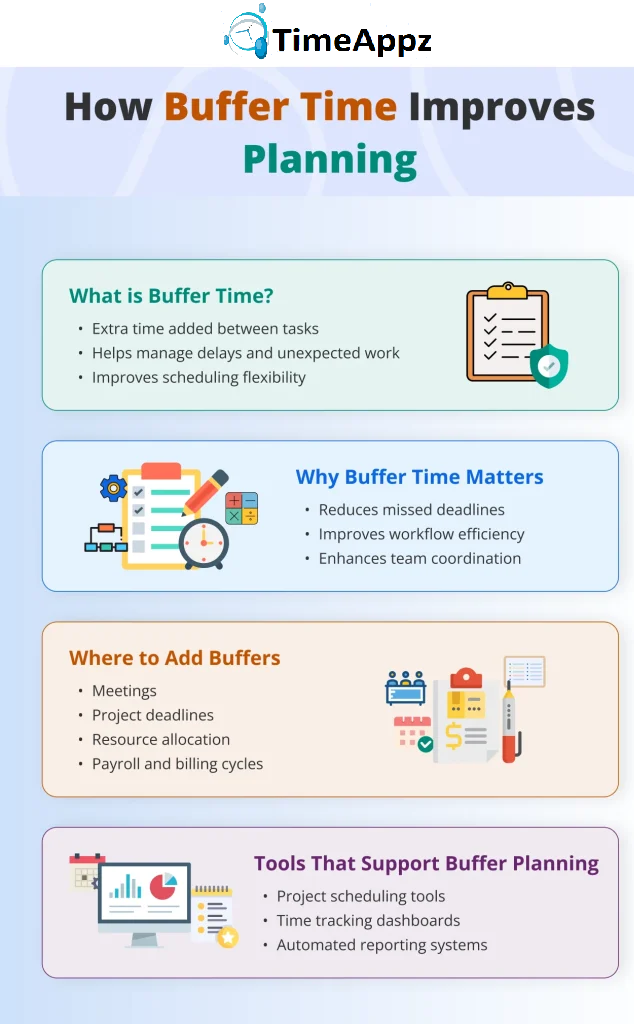
Buffer time meaning refers to the additional time added between scheduled tasks to hold unexpected delays or interruptions. Rather than overloading a schedule, buffers create a breathing space that allows workflows to remain stable even when disruptions happen. For instance, consider a team working with project management software. Without buffer time, meetings may run late, which could cause other delays during the day. With buffers, teams maintain actual timelines and avoid stress from constant rescheduling. Time buffers are valuable in environments where tasks depend on one another. Industries such as healthcare, manufacturing, and logistics benefit from using buffer strategies with Time Tracking Software to observe how time is actually spent.

What Are the Benefits of Incorporating Time Buffers into Schedules?
Time buffers improve efficiency and employee well-being. Below are some benefits organizations experience when buffer time is a part of routine planning:
1. Reduced Delays
Buffer periods absorb unexpected delays and disruptions.
2. Better Accuracy
Schedules turn into realistic and achievable outcomes.
3. Improved Team Productivity
Employees move smoothly between tasks.
4. Increased Client Satisfaction
Consistency is achieved to meet deadlines.
5. Less Stress
Flexible plans mean teams are less pressured to achieve everything together. The New York Times article explains that with frequent breaks, mental recovery improves and mistakes are reduced, which supports better productivity. It reinforces the idea that constant work can hurt performance, and recovery time improves output.
Best Software Tools That Support Buffer Planning
To manage buffer scheduling efficiently, organizations rely on technology. The right tools allow teams to integrate buffers into workflows without the process being complex.
Key Features to Look for in Buffer Planning Tools
| Feature | Why It Matters |
| Scheduling Tools | Helps create time gaps between tasks |
| Reporting Dashboards | Identifies workflow bottlenecks |
| Integration Capabilities | Connects scheduling with billing and HR |
| Automation | Reduces manual planning errors |
| Mobile Access | Allows real-time updates |
Solutions like project management software, time tracking software, and payroll hours tracking software make it easier to manage scheduling gaps and monitor productivity trends.
What Are the Best Software Tools for Buffer Planning in Manufacturing?
Manufacturing industries depend on strict scheduling. Even a minor delay can completely disrupt production lines. To resolve this matter, many companies use the best software tools for buffer planning in manufacturing that combine resource scheduling with buffer allocation.
- Job scheduling becomes automated.
- Tracking dashboards provides real-time insights.
- Efficient management of available resources.
- Workforce visualization.
Benefit to manufacturers from tools
When buffer strategies and Time Tracking Software are combined, manufacturers can accordingly observe downtime patterns and adjust schedules.
How to Implement Buffer Planning in Supply Chain Management Quickly?
The supply chain network involves multiple stakeholders. This means delays are unavoidable. However, when structured buffer strategies are implemented, they maintain the operational flow.
- Recognize critical workflow stages.
- Measure average delays by using reporting tools.
- Add practical buffer intervals.
- Monitor results by using real-time dashboards.
- Use performance data to adjust buffer sizes.
Steps to Implement Buffer Planning
Organizations that use payroll hours tracking software integrate supply chain schedules with workforce availability, ensuring resources are allocated properly.
Best Mobile Apps for Real-Time Buffer Planning Updates
Modern teams need flexibility and mobility. With the availability of best mobile apps for real-time buffer planning updates, managers can update schedules quickly and make buffer adjustments simple and effective. Mobile tools usually provide:
- Immediate notifications.
- Updates on schedules in real-time.
- Features of team collaboration.
- Access to productivity metrics.
For instance, healthcare organizations use time tracking software for healthcare to ensure the staff schedule includes appropriate buffer periods between patient appointments. This approach improves patient satisfaction and reduces staff burnout.
Learn More About Time Tracking
Get a Quote for Buffer Analysis Consulting
Most organizations struggle to understand how much buffer time is necessary. Consulting services help analyze workflows and recommend the maximum buffer duration. They help get a quote for buffer analysis consulting. Professional buffer analysis includes:
- Review of workflows.
- Evaluation of schedule patterns.
- Analysis of resource utilization.
- Recommendations for a custom buffer.
Companies that utilize structured buffer consulting report significant improvements in deadline consistency and team efficiency.
The Role of Technology in Modern Buffer Planning
Technology is driven by planning, and this has transformed how businesses manage time. Modern systems integrate scheduling, billing, reporting, and workforce management into a unified platform. By combining project management software and time tracking software, businesses gain visibility into everyday operations. Over time, with this transparency, managers can refine buffer intervals and improve performance metrics.
Conclusion
Achieving buffer scheduling is not as simple as adding extra minutes to a calendar. It is about designing a workflow that supports productivity, reduces stress, and improves reliability across teams. By understanding the buffer time meaning and applying structured buffer planning, organizations can create schedules that meet real-world demands.
Frequently Asked Questions
What is buffer time and why is it important?
- Buffer time refers to extra time added between scheduled tasks to manage delays. It helps reduce stress and ensures workflows remain consistent. Teams benefit from improved efficiency and fewer missed deadlines.
How much buffer time should be added between tasks?
- The ideal buffer duration depends on task complexity and risk of delays. Many organizations start with 10–20% of the task duration. Over time, performance data helps refine buffer intervals.
Can buffer planning improve employee productivity?
- Yes, buffer planning improves productivity by reducing scheduling pressure. Employees work more efficiently when they have time to transition between tasks. This approach also supports better time management habits.
Which industries benefit the most from buffer planning?
- Industries such as healthcare, manufacturing, logistics, and consulting benefit greatly. These sectors rely on precise scheduling and continuous workflows. Buffer time helps maintain consistency and service quality.
Is buffer planning suitable for small businesses?
- Absolutely. Small businesses often face resource limitations, making buffer planning even more valuable. With the right tools, even small teams can manage schedules effectively and avoid unnecessary delays.
🎯 Move From Volatile Reactivity to Total Operational Sovereignty
Allowing your operations to run on over-packed calendars, loose spreadsheet trackers, or manual scheduling habits is an expensive liability that breeds workforce burnout, delivery delays, and hidden margin erosion. ProjecTime by TimeAppz replaces scheduling guesswork with an integrated, high-velocity resource capacity and buffer planning engine. Protect your target milestones, achieve absolute data governance, and deploy safely on our optimized cloud or run completely On-Premises behind private company firewalls.
Permanently Free Plan
Perfect for small teams and independent consultants. Holds core timesheets, baseline billing features, and support for up to 2 users and 1 project permanently.
Advanced Resource Optimization Plan
Unlock our 30-Day Full-Feature Trial—no credit card required. Experience automated buffer mapping, real-time workload heatmaps, cross-project data tracking, and native payroll ledgers integration.

Related Blogs
 DCAA Timekeeping Requirements: A Practical Guide for Government Contractors
If your organization holds a cost-reimbursable, time-and-materials, or labor-hour government contract
TimeAppz
 Timesheet Reminders: How to Ensure On-Time Submission Every Week
Late timesheet submissions are a management problem before they are an employee
TimeAppz
 Timesheet Approval Process: Best Practices for Teams
A timesheet without an approval is not a reviewed document. It is
TimeAppz