Capital Optimization via Centralized Workforce Governance: Eliminating the Margin Erosion of Siloed Labor Systems
Workforce Management Made Simple
Track time. Manage schedules. Improve payroll accuracy.
Understanding workforce management software
Workforce management software examples help organizations by organizing the following in a system:
- Plan staffing.
- Track hours worked.
- Manage attendance.
- Align schedules with business.
These platforms replace manual spreadsheets with automated time capture, approval of workflows, and reporting, which allows managers to make decisions based on real-time data. According to workplace research frequently covered in Harvard Business Review’s time management and workforce planning insights, structured time tracking and visibility significantly improve operational clarity and long-term planning. A strong workforce solution includes time tracking, scheduling, leave management, and integration of payroll or billing tools. For remote and hybrid teams, a combined time and attendance system is essential for maintaining fairness, transparency, and compliance across locations.
Top workforce management software examples
Below are widely used workforce management software examples that handle time tracking and scheduling in different ways:
ProjecTime by Timeappz
Focuses on integrated time tracking, attendance, projects, expenses, and reporting in a single platform. Best for: Organizations that require structured approvals, payroll-ready data, and visibility across various teams and locations.
DeskTime
Focuses on workforce analytics, automatic time tracking, and productivity insights that provide data on how and when teams work. Best for: Companies seeking real-time metrics and basic scheduling to improve utilization and focus.
- Basic timers and lightweight tools aimed at individuals or small teams.
- A workforce management suite includes shift planning, predictions, and labor cost optimization.
Other common categories
The features of ProjecTime by Timeappz go beyond a basic timer. It unifies time tracking, attendance, leave, project goals, and expenses in a single platform for better productivity and efficiency.
Spotlight: ProjecTime by Timeappz
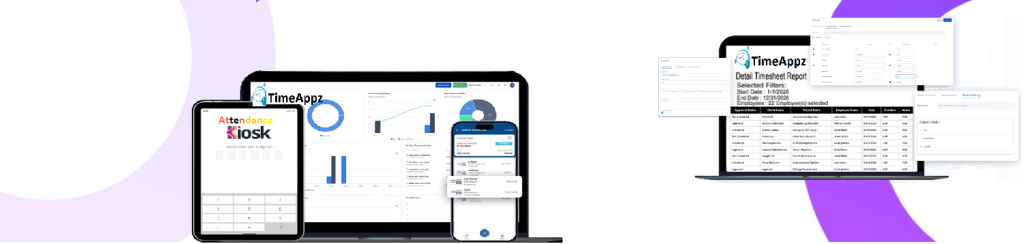
ProjecTime by Timeappz is one of the workforce software management examples that is designed as a comprehensive time tracking and attendance platform to support teams, along with larger, multi-department organizations. Employees can log hours via the web, kiosk, or mobile applications, and managers review and approve time entries through structured workflows. The approved data flows into payroll, billing, and reporting, reducing manual corrections, and improving accuracy. Key features
- Digital timesheets for daily, weekly, or project-based entries for employee time tracking.
- Tracking attendance and shift, including overtime calculations and adaptable work.
- Tracking projects and tasks, helping leaders to understand how time is spent across clients.
- Planning coverage and avoiding understaffing with leave and PTO management.
- Tracking and managing expenses and multi-currency costs for project-based organizations.
- Reporting and analytics highlight trends in overtime, labor costs, and utilization.
Since the system supports remote, hybrid, and field-based teams, managers can gain consistent visibility without constraining employees to manual entries or ad-hoc tools.
How to track time working from home
Employees who want to understand how to track time working from home, seek to find a balance between structure and flexibility. ProjecTime by Timeappz supports remote teams by allowing them to record work hours through web or mobile apps (fixed shifts or flexible schedules). Moreover, managers can establish guidelines for daily or weekly timesheet submission without resorting to constant observation. As discussed in Monitoring Remote Workers by Forbes Agency Council, companies that thrived relied more on trust and outcome-based accountability than strict surveillance. Practical tips for remote time tracking
- Explain core hours when teams come together for collaboration and approval.
- Use project or task codes, so time entries show the combined data of how long people worked and what they worked on.
- Motivate employees to log hours in real-time or close enough to reduce forgotten hours and inaccuracies.
- Analyze weekly reports about workload distribution and overtime issues. Adjust assignments or staffing as required.
For example, an article by Forbes Human Resources Council emphasizes evaluating employees based on outcomes rather than screen time. A structured, yet flexible approach helps remote workers remain responsible while having independence during the day
Time tracking benefits for businesses
The time tracking benefits for modern platforms are beyond just knowing when employees begin and finish work. When time data is accurate, it supports payroll, billing, compliance, and strategic planning by providing leaders with an understanding of how labor hours translate into business goals. Major benefits:
- Payroll accuracy is improved: Approved time entries convert into payroll-ready data, reducing errors and manual rectification.
- Project visibility is better: Managers can compare hours spent against budgets to observe which projects are on schedule or occupy unnecessary time.
- Better compliance: Consistent records of work hours, overtime, and leave provide documentation for audits and labor regulations.
- Productivity boost: With real-time visibility, it is easier to minimize low-value activities and focus on important work.
A published example by Timeappz notes that a global SaaS company using Timeappz time tracking saw a 25 percent improvement in task completion and a 10 percent reduction in overtime after a month of structured tracking. Additionally, Forbes highlights that mistrust in remote settings is a result of unclear objectives, recommending defined success metrics and outcome-focused check-ins.
Informative table: Workforce management focus areas
Below is a high‑level table that illustrates how different solution types focus on various aspects of workforce management.
| Solution Type | Time Tracking Depth | Scheduling & Shifts | Analytics & Reporting | Ideal Use Case |
| ProjecTime by Timeappz | Detailed timesheets, projects, attendance, overtime | Support shifts, leave, and work rules | Robust reports on utilization, costs, and attendance | Growing organizations needing integrated time, attendance, and project tracking |
| Basic Timer Apps | Simple start/stop timers | Minimal or none | Limited, often basic summaries | Freelancers and very small teams |
| Activity-Monitoring Tools | Automatic desktop tracking | Limited scheduling | Productivity dashboards and app/website usage stats | Teams focused on digital activity and focus metrics |
| Full WFM Suites | Integrated with HR and payroll | Advanced forecasting and shift optimization | Labor cost, forecast vs. actual, compliance reports | Large enterprises with complex staffing and compliance needs |
This table shows why a solution like ProjecTime by Timeappz is well suited for organizations that need more than basic timers but do not necessarily require an enterprise HR suite.
Conclusion
Effective workforce management software examples highlight when time, attendance, projects, and scheduling are unified on a single platform. With this, organizations gain clarity and control over how work happens. ProjecTime by Timeappz combines these tools together that help teams understand how to track time from home and, in the office, while capturing time tracking benefits that support productivity, payroll accuracy, and compliance. Ready to see the difference? Explore Timeappz today or request a personalized demo. Discover how complete visibility transforms teams. You can reach the team at [email protected] or Live ChatThe Live Chat option is in the bottom-left corner!← Look Left to explore implementation options tailored to your construction operations.
Frequently asked questions
What is workforce management software?
- Workforce management software is a set of tools that help organizations plan staffing, track working hours, and manage attendance and leave in a single system. By merging these functions, it replaces manual spreadsheets and fragmented workflows with structured, repeatable processes. The result is better alignment between staffing levels, business demand, and labor costs.
How does ProjecTime by Timeappz help remote teams?
- ProjecTime by Timeappz supports remote and hybrid teams through web, mobile, and kiosk access, allowing employees to log time and attendance from any location. Managers can configure approval of workflows and view real‑time reports, giving them visibility without constantly checking in with individual employees. This helps remote workers stay accountable while maintaining flexibility in how they organize their day.
Why is accurate time tracking important for payroll?
- Accurate time tracking ensures that payroll reflects actual hours worked, including overtime and approved leave. When time data is captured and approved in a structured system, it reduces the risk of underpayment, overpayment, and disputes with employees. Automated calculations also lower the administrative burden for HR and finance teams.
How can I encourage my team to use time tracking tools?
- To increase adoption, explain the time tracking benefits, such as fairer workload distribution, transparent overtime, and smoother payroll. Keep the process straightforward by using tools like ProjecTime by Timeappz that integrate time, attendance, and projects in one place and minimize extra clicks. Finally, use insights from reports to make visible improvements, like adjusting workloads or recognizing high‑performing teams, so employees see tangible value in accurate tracking.
Is workforce management software only for large companies?
- No, workforce management tools are increasingly used by small and midsize businesses that need reliable scheduling, time tracking, and attendance oversight. ProjecTime by Timeappz, for example, is designed to support both small teams and large organizations, scaling as operations grow and become more complex. Even a small, distributed team can benefit from centralized time tracking and clear visibility into how work hours are spent.
🎯 Move Beyond Disjointed Tracking Tools to Total Workforce Sovereignty
Allowing your distributed, hybrid, or multi-department operations to run on static spreadsheets, scattered emails, or disconnected single-feature applications is an expensive corporate liability. It directly breeds payroll inflation, billing errors, and massive utilization leakage. ProjecTime by TimeAppz closes the operational gap by unifying real-time timesheets, shift attendance, leave tracking, and project expense sheets under a single, data-driven console. Take complete control of your billable realization metrics, deploy safely on our optimized cloud, or run completely On-Premises behind private company firewalls.
Permanently Free Plan
Perfect for independent consulting teams and early-stage boutique agencies. Holds core timesheets, baseline billing features, and support for up to 2 users and 1 project permanently.
Advanced Resource Optimization Plan
Unlock our 30-Day Full-Feature Trial—no credit card required. Experience automated multi-rate workflows, live check-in dashboards, cross-project data tracking, and native payroll ledgers integration.
Related Blogs
 DCAA Timekeeping Requirements: A Practical Guide for Government Contractors
If your organization holds a cost-reimbursable, time-and-materials, or labor-hour government contract
TimeAppz
 Timesheet Reminders: How to Ensure On-Time Submission Every Week
Late timesheet submissions are a management problem before they are an employee
TimeAppz
 Timesheet Approval Process: Best Practices for Teams
A timesheet without an approval is not a reviewed document. It is
TimeAppz