
Capital Optimization via Strategic Capacity Allocation: Eradicating Performative Busyness and Hidden Labor Leaks

Another week has ended. Your team’s calendars were packed, chat threads buzzed non-stop, and everyone seemed buried in work. Yet, that crucial project milestone was missed again.
If this scene feels familiar, you’re likely asking yourself the manager’s most frustrating question: Why is my team always busy but never truly productive?
This chronic gap between effort and results isn’t a sign of a lazy team. It’s the direct cost of a system where time management has been downgraded to a personal skill, rather than leveraged as your most powerful business strategy.
This guide moves beyond simple life-hacks. We will dismantle the core reasons why time management is important in the workplace, revealing how a strategic approach directly solves your biggest leadership headaches: the lack of visibility into daily work, the impossibility of tracking time across projects, and the silent profit drain of chronic inefficiency.
Key Takeaways
- Transform time management from a personal skill into a profitability engine by eliminating wasted time and boosting output.
- Create a more resilient team by using time management as a proven tool for reducing stress and preventing burnout.
- Gain clear, actionable visibility into team performance and workflow bottlenecks to make smarter decisions.
- Build a reputation for unshakeable reliability that strengthens client trust and gives you a competitive edge.
What is the Real Cost of Poor Time Management at Work?
Before we solve the problem, let’s understand its full impact. Disorganization creates a domino effect that hurts your entire business, from your bottom line to your team’s spirit.
How Much Time is Actually Wasted?
The data paints a clear picture of fragmented workdays. Research cited by Forbes found that employees spend just 45% of their time on primary job duties, with the rest consumed by emails, meetings, and administrative tasks. This constant task-switching has compounding case studies highlighted by Harvard Business Review show it can take over 20 minutes to regain deep focus after each interruption. These lost hours and broken focus periods translate directly into lost revenue, stifled growth, and missed opportunities. To put this abstract problem into perspective, consider how it plays out in a real project.
A Real-World Scenario: The Failed Project Launch
Imagine a software team, “TechNovate,” launching a new feature. Without a clear schedule, developers sit idle waiting for delayed designs. Quality assurance then has to rush their tests, causing them to miss critical bugs. The launch fails, a key client is lost, and team morale plummets. This wasn’t a failure of skill, but a direct result of poor time management and planning. The lack of a clear timeline and accountability created this preventable domino effect.
How Can Better Time Management Transform Your Business?
So, how does this disciplined approach help? It’s more than just checking off tasks. It’s about creating a fundamental shift in how your team operates, which is precisely why time management is important in the workplace. This systematic method delivers transformative benefits across your organization.
1. How to Skyrocket Team Productivity and Efficiency
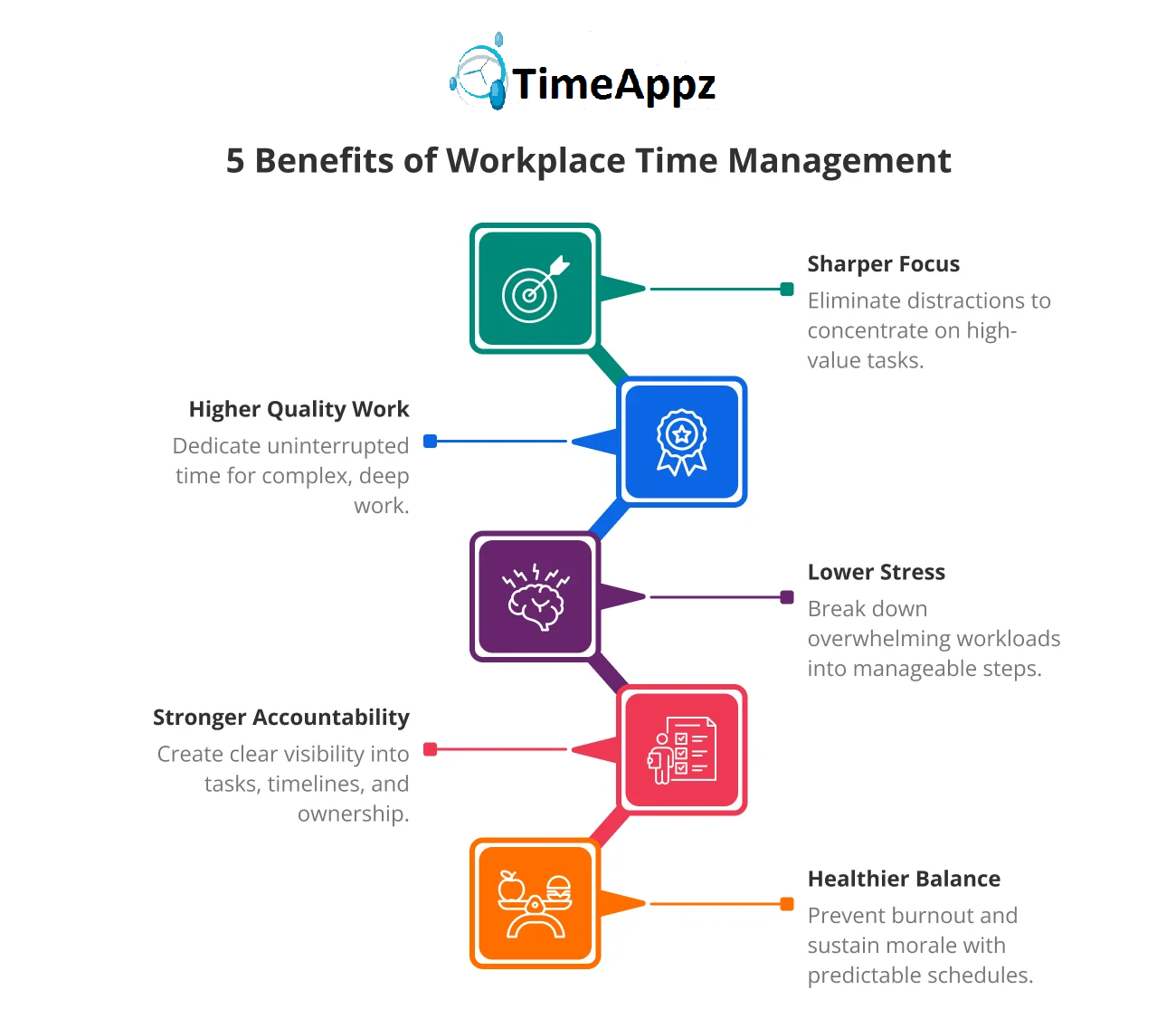
Simply put, a structured approach to time eliminates waste. When your team has a clear plan and priorities, they spend less time deciding what to do and more time executing high-value work. This concentrated effort leads to faster project completion and higher-quality output, making your entire operation more efficient and profitable.
2. Can Time Management Really Reduce Workplace Stress?
Yes, absolutely. The constant pressure of looming deadlines and an overflowing inbox is a major cause of chronic stress and burnout. This systematic method helps by giving your team a crucial sense of control. As productivity expert David Allen, creator of the Getting Things Done (GTD) method, says, “You can’t manage time; you can only manage yourself in relation to time.” By proactively scheduling tasks and setting boundaries, the overwhelming mountain of work becomes a series of manageable steps. This reduces anxiety and creates a healthier, more sustainable work-life balance for everyone.
3. How to Improve Decision-Making and Strategic Focus
Beyond reducing stress, this approach is key to unlocking your team’s strategic potential. When are they supposed to innovate if they’re always putting out fires? Often, they can’t. This reactive state kills creativity. This is where the concept of “Deep Work” coined by author Cal Newport becomes essential. Deep Work is the ability to focus without distraction on cognitively demanding tasks. Key Insight: Deep work is impossible without protected time. Good time management is the system that creates and guards these blocks of uninterrupted concentration, allowing your team to do their most valuable thinking. By batching small tasks and minimizing interruptions, you free up mental energy for superior decision-making and long-term planning.
4. How Does Time Management Build a Better Company Culture?
Trust is built on reliability. A team that consistently meets deadlines builds a rock-solid reputation with clients and within itself. This reliability fosters a positive company culture. When people aren’t constantly bailing each other out of last-minute crises, team morale and collaboration improve. This sense of pride and shared success is crucial for employee retention.
5. How to Gain Visibility and Foster Accountability
For managers, a lack of visibility into what the team is working on is a major frustration. How do you know if a project is on track? A structured approach creates natural transparency. Using shared tools and methods makes workflow and progress clear to everyone. This visibility leads to better accountability. When tasks and timelines are clear, ownership is unambiguous. This allows for fairer performance reviews and helps you spot bottlenecks before they become major delays. Here’s a quick look at how common visibility problems translate into actionable solutions:
| Common Symptom | Practical Solution for Managers |
| Projects are always behind schedule. | Use a shared project management tool like Asana for real-time project tracking. |
| You don’t know how long tasks truly take. | Do a one-week time audit to get accurate data for planning. |
| The team is constantly interrupted. | Use the Eisenhower Matrix to teach task prioritization (urgent vs. important). |
| Everyone is busy but output is low. | Implement time blocking to protect focus time and reduce task-switching. |

What Does a Time Management Success Story Look Like?
Let’s take a real-world example. “DesignFlow Agency” was struggling with late deliveries, high team stress, and a general lack of visibility into their workflow. Their leadership decided to tackle the problem with a clear, three-step intervention:
- They conducted a company-wide time audit to get accurate data.
- They trained everyone on the principles of time blocking.
- They introduced “Focus Fridays,” a policy of no internal meetings.
The results were transformative. Project delays dropped by over 50%, and team morale improved significantly. An unexpected benefit was a 30% reduction in total meeting time, as the remaining meetings became more focused and intentional. This gave everyone back hours each week, dramatically improving workload management and overall job satisfaction. The methods “DesignFlow” used are just some of the proven frameworks available. Here are other powerful techniques to consider for your team.
What Are the Best Time Management Techniques to Try?
You don’t need to reinvent the wheel. These proven frameworks can help your team immediately. The Eisenhower Matrix: This tool helps with task prioritization by sorting tasks into four quadrants:
- Urgent/Important (Do first)
- Not Urgent/Important (Schedule)
- Urgent/Not Important (Delegate)
- Not Urgent/Not Important (Eliminate)
The Pomodoro Technique: This method uses a timer to break work into intervals, traditionally 25 minutes of focused work followed by a 5-minute break. It’s excellent for maintaining concentration, preventing burnout, and making large tasks less daunting. (This is a perfect complement to time blocking for managing focus within scheduled blocks).
How Can You Start Improving Time Management Today?
Ready to see a change? Here is a simple, 3-step action plan you can start next week. Do a Time Audit: For one week, have everyone track their time. The goal is awareness, not judgment, to identify the biggest time-wasters. Hold a Team Workshop: Discuss the findings together. Where are the bottlenecks? This collaborative review builds crucial buy-in for change. Implement ONE New Practice: Don’t try to change everything at once. Start with one thing, such as introducing “No-Meeting Wednesdays,” holding a training on the Eisenhower Matrix, or having the team try time blocking for their top two daily priorities. Choose one step and implement it this week. The most valuable resource you have is time, and the best time to start is now.
Conclusion
Understanding why time management is important in the workplace is the first step toward building a stronger, more resilient business. It’s the crucial link between a healthy bottom line and a happy, high-performing team. Mastering time isn’t about doing more; it’s about ensuring your team’s energy is strategically invested in the work that truly moves the needle, driving productivity, fostering innovation, and securing a competitive advantage. Ready to make time your strategic advantage? Contact Timeappz today at [email protected] or Live ChatThe Live Chat option is in the bottom-left corner!← Look Left to explore implementation options tailored to your construction operations.
Frequently Asked Questions
What is the most important benefit of time management?
-
The most critical benefit is the reduction of workplace stress. When teams have control over their workload and deadlines, it creates a foundation for higher productivity, better creativity, and improved employee retention. This directly addresses why time management is important in the workplace for maintaining a healthy organizational culture.
What’s the difference between being busy and being productive?
-
Being busy is about activity and motion, while being productive is about achievement and outcomes. Effective time management provides the focus and prioritization needed to ensure effort leads to meaningful results that advance business goals.
Can time management improve work-life balance?
-
Yes, absolutely. By creating clear boundaries through proper scheduling and eliminating constant last-minute work, employees can more reliably disconnect after hours. This is essential for preventing burnout, sustaining team morale, and ensuring long-term employee retention.
How can I help my team with time management without micromanaging?
-
Focus on empowerment through the right tools and training rather than surveillance. Provide frameworks like time blocking and clear task prioritization systems, then trust your team to manage their execution. This approach builds accountability while respecting autonomy.
What’s the first step an employee can take toward better time management?
-
Start with a simple time audit. Tracking how you spend your time for 3-5 days provides crucial awareness of time-wasters and patterns. This data-driven approach reveals the most impactful opportunities for improvement in personal productivity.
Is time management a skill you can train?
-
Yes, it’s a highly trainable soft skill. Through targeted workshops and consistent practice of methods like the Pomodoro Technique or Eisenhower Matrix, anyone can significantly improve their time management proficiency and workflow optimization.
How do you measure the ROI of time management?
-
Track concrete metrics like on-time project completion rates, reduction in overtime costs, improved employee engagement scores, and decreased missed deadlines. These key performance indicators provide clear evidence of improved workflow optimization and business impact.
How does poor time management affect customers?
-
The impact is direct and significant. Missed deadlines, rushed work, and communication delays damage your company’s reputation for reliability. This erosion of trust directly hurts customer satisfaction and long-term retention.
What is the biggest myth about time management?
-
The biggest myth is that it’s about doing more things faster. In reality, effective time management is a system for strategic decision-making about your focus and energy, ensuring you do the right things effectively rather than simply more things.
Are time management tools necessary for success?
-
While not strictly mandatory, the right tools and technology are powerful enablers for teams. They provide the structure, visibility, and accountability needed to manage complex projects effectively and maintain team alignment.
How does ProjecTime by Timeappz approach time management differently?
-
ProjecTime by Timeappz provides a unified workflow optimization platform that integrates project tracking, time auditing, and performance analytics into one system. This gives managers holistic visibility into team capacity and project health, enabling proactive adjustments and fostering a data-driven culture of accountability.
Can ProjecTime by Timeappz help with remote team time management?
-
Absolutely. The platform is built for distributed teams, offering clear visibility into workloads and project progress without micromanagement. Features like shared dashboards, automated time tracking, and integrated goal-setting ensure all team members remain aligned and accountable, regardless of location.
🎯 Move Beyond Chaos to Absolute Operational and Workforce Sovereignty
Allowing your workforce to operate on unverified habits, fragmented calendar blocks, or manual spreadsheet math is an expensive corporate liability. It directly causes employee burnout, missed project milestones, and silent profit erosion. ProjecTime by TimeAppz replaces manual friction with a centralized, automated resource allocation and time tracking platform. Take absolute control of your billable realization metrics, deploy safely on our optimized cloud, or run completely On-Premises behind private company firewalls.
Permanently Free Plan
Tailor-made for independent consulting teams and early-stage boutique agencies. Holds core timesheets, baseline billing features, and support for up to 2 users and 1 project permanently.
Advanced Resource Optimization Plan
Unlock our 30-Day Full-Feature Trial—no credit card required. Experience automated multi-rate workflows, live check-in dashboards, predictive capacity analytics, and native payroll integrations.

Related Blogs
 DCAA Timekeeping Requirements: A Practical Guide for Government Contractors
If your organization holds a cost-reimbursable, time-and-materials, or labor-hour government contract
TimeAppz
 Timesheet Reminders: How to Ensure On-Time Submission Every Week
Late timesheet submissions are a management problem before they are an employee
TimeAppz
 Timesheet Approval Process: Best Practices for Teams
A timesheet without an approval is not a reviewed document. It is
TimeAppz