
Capital Optimization via the Cycle Time Formula: Eliminating Operational Bottlenecks and Idle-Time Capital Leakage

Introduction
Understanding the cycle time formula is crucial for enhancing operational efficiency and relevant performance tracking across processes. Be it production lines, services workflow, or project timelines, cycle time serves as a useful indicator to pinpoint bottlenecks, optimize resource allocation, and improve productivity. We will cover the cycle time formula and its importance and detail actionable steps in how to calculate it effectively in this tutorial.
Optimize Your Workflow Today
See how ProjecTime helps track and improve cycle time.
This formula for cycle time is not just some conceptual or theoretical thing; it’s a very handy tool for any enterprise concerned with operational excellence. We will also discuss some related concepts like the formula to calculate cycle time and ideal cycle time formula in order to provide an overall understanding. If you are using tools like time tracking software, you can even automate this calculation of the cycle time right down to tracking real-time data.
What is Cycle Time?
Cycle time refers to the time taken by completion of one entire cycle whichever ongoing activity, product, or process. It means the total time taken right from the very beginning of an activity to its end. The understanding of cycle time has become essential for those companies who want to increase their levels of productivity and customer satisfaction.
For instance, in manufacturing, cycle time could refer to the time it takes to produce a single piece. In project management, it is the time required for one type of activity in relation to an overall project.
Why is Cycle Time Important?
- Efficiency measurement: It identifies the inefficiencies and bottlenecks of a process.
- Resource Optimization: It serves to optimize resources.
- Customer Satisfaction: Shortened cycle times often mean quicker deliveries and better service.
- Benchmarking: Sets standards of performance and monitors the progress against them.
It helps businesses to work out the cycle time and, therefore, refine their workflows for better delivery of results.
Understanding the Formula for Cycle Time
The formula to calculate cycle time is straightforward:

Components of the Formula:
- Total Time Taken: This is the total duration required to complete a process or produce a set of items.
- Quantity Produced: Number of units completed over that period.
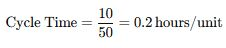
For example, if a team takes 10 hours to make 50 units, the cycle time is:
How to Calculate Cycle Time Step by Step
- Define the Process: Clearly define what you are trying to measure, identifying the start and end points of the process.
- Record Total Time: The total time of the worker can be recorded with the help of a stopwatch, time tracking software, or by logging it manually.
- Count Completed Units: Find the total number of units or tasks that have been completed within the time measured.
- Formula: Divide the total time by the number of units to arrive at the cycle time.
Key Considerations for Cycle Time Calculation
- Accuracy of Time Measurement
- Batch Sizes
- Process Variability
Make the time measurement account for every activity that happens, including delays or interruptions. Timesheet tracking software will also help maintain accuracy.
For batch processed units, determine cycle time for a single unit by dividing total time by the number of items in the batch.
Consider the different jobs or units in relation to their variations in processing time. Averages can be used to smooth out inconsistencies.
- Identification of Bottlenecks: Directly determine the reasons behind longer cycle times in steps and eliminate inefficiencies.
- Improve Workflows: Automate and optimize processes to save time in general.
- Set Realistic Goals: Use benchmarks, like the optimum cycle time formula, to calculate realistic targets.
- Improve Resource Allocation: Allocate resources to tasks or processes requiring more time.
- Automatic Data Collection
- Real-time tracking
- Accurate Reportage
- Customized Dashboards
What is the Ideal Cycle Time Formula?
The ideal cycle time formula stands for the smallest time that has to be spent by a process under the best conditions, with no delays, no downtime, and no waste of any kind.

This formula makes it easy to set benchmarks and identify gaps between actual performance and potential efficiency.
For example, if a machine can theoretically produce in 100 units in 8 hours:

Practical Examples of Formula for Cycle Time Example 1: Manufacturing A production line produces 200 units from 5 hours. What is the cycle time?


These steps make it easier to apply the cycle time formula, and the improvement can be tracked for some time. See Also: What are the Core Principles of Time Management?
Conclusion
The cycle time formula forms the basis of any organization in its desire to make things more efficient and cut down on wasting time. Much about it, along with the concept of the ideal cycle time formula, helps businesses find inefficiencies in their processes, set realistic goals, and work towards perfecting those workflows. Adding to that, tools such as time tracking software further enhance the accuracy and use of the cycle time calculation. Take the first step at perfecting those processes by measuring cycle time today!

Frequently Asked Questions
What does the cycle time formula measure?
- The cycle time formula measures the total time required to complete one unit of work or process from start to finish.
- Cycle time focuses on the actual processing time to complete a task, while lead time includes waiting periods and the total time from request to delivery.
- Calculating cycle time helps identify bottlenecks, improve workflow efficiency, optimize resources, and reduce delays in production or service delivery.
- Yes. Time tracking software automatically records task durations, making it easier to calculate cycle time accurately and monitor performance in real time.
- For product inquiries, demos, or pricing details, contact ProjecTime by Timeappz today at [email protected] or Live ChatThe Live Chat option is in the bottom-left corner!← Look Left to explore implementation options tailored to your construction operations.
🎯 Put Your Cycle Time Analytics and Process Optimization on Autopilot
Relying on retroactive human memory, manual stopwatches, or clunky paper logs to compute your process cycle times is an expensive operational liability that leads to undetected bottlenecks, misallocated personnel, and margin erosion. ProjecTime by TimeAppz replaces manual tracking friction with a centralized, automated throughput analytics engine. Take absolute control of your factory or workflow efficiency, deploy safely on our optimized cloud, or run completely On-Premises behind private company firewalls.
Permanently Free Plan
Perfect for small operational teams and specialized independent workshops. Holds core timesheets, baseline billing tools, and support for up to 2 users and 1 project permanently.
Advanced Throughput Analytics Plan
Unlock full features via our 30-Day Free Trial—no credit card required. Experience automated cycle time mapping, predictive capacity dashboards, multi-site location routing, and native enterprise ledger syncing.

Related Blogs
 DCAA Timekeeping Requirements: A Practical Guide for Government Contractors
If your organization holds a cost-reimbursable, time-and-materials, or labor-hour government contract
TimeAppz
 Timesheet Reminders: How to Ensure On-Time Submission Every Week
Late timesheet submissions are a management problem before they are an employee
TimeAppz
 Timesheet Approval Process: Best Practices for Teams
A timesheet without an approval is not a reviewed document. It is
TimeAppz