Effective Employee Productivity Measures with Time Tracking Software
Introduction
Why measurement matters more than micromanagement
When companies know their main objective is productivity, many teams choose one of two habits: estimating how to use time, or reinforcing control to fulfill outputs. But neither of them works because the former allows inefficiencies to build up, and the latter breaks faith and creativity.
However, there is a third way: to measure outcomes and workflows, not people. Track time and tasks so that the real questions can be answered:
- What projects are exhausting the resources?
- Who is burdened with extra work?
- What small process changes will give the maximum return?
Employee productivity monitoring software confirms that it’s a neat, ethical, and usable insight into work patterns for businesses, so that instead of monitoring people, operations can be streamlined.
The state of work: the hard numbers you should care about
Some of the recent findings prove the case for structured measurement:
- According to Harvard Business Review, researchers warn that basic surveillance, such as keystroke logging and screen capture, can rebound and break trust. But if productivity measures are well-designed and used properly, the workflow can reveal constraints and management can work better to fix them.
- As noted by Harvard Business Review, if employee care is not monitored, it can increase risk and aggressive behavior between teams. This is the main reason why policy and transparency matter.
- One article by Forbes says that the constant feeling of not having any real free time to work with (time poverty) is increasing and, in recent times, has developed into a leadership problem. Lack of proper planning can quietly take all the company’s quality time.
- Another article by Gartner shows that employees have difficulty obtaining the right information due to disorganized tools, hard-to-understand documentation, or poor research skills. The time lost due to these issues is a hidden cost that no type of monitoring can fix unless the actual systems improve.
- As mentioned in the article by WIRED, when work became remote, many companies had equipment that provided a better understanding of employees’ devices and activities. Although these provided data, they also raised concerns about trust, autonomy, and the psychological impact of constantly having employees under observation, especially if used without proper communication or agreed-upon policies.
These findings show that modern time tracking must be an important addition to employees’ well-being at the workplace, and not surveillance.
Core productivity measures enabled by time tracking software
The list below outlines the essential metrics and measures companies should track, keeping an ethical, and transparent time tracking approach in mind.
1. Time-on-task (granular task timing)
Each task performed by the employee should be tracked specifically. Granular timing reveals tasks that frequently exceed the original estimate, allowing you to either modify the work or eliminate inefficiencies.
2. Utilization & capacity rates
A simple calculation to identify this is: Utilization = (productive/billable hours) ÷ available hours. This helps to know whether employees are inefficiently assigned and helps balance work burdens to avoid burn out, or not using resources as much as they should be used.
3. Billable vs non-billable breakdowns
Firms with a service background are split between client-billable and internal admin work, which directly affects margin. This division allows managers to reallocate low-value tasks or automate them.
4. Project variance & forecasting
When a company adapts to real-time time sheets that link directly to project budgets, it helps in identifying cost increase early. When reports are properly forecasted, last-minute issues or unexpected project loss can be corrected.
- If people are wasting time by frequently switching work conditions.
- If repeated meetings are breaking the workflow.
5. Idle time, interruption frequency, and task switching
Software can show instant patterns such as:
These signs point to policy or scheduling fixes.
6. Time-off & attendance analytics
When employees take time off, it changes how much work a team can handle. It can naturally influence workload planning and capacity projections.
Integrations with employee time off tracking software allows the HR team and other departments to plan with data for expected and unexpected leave.

How to measure without demoralizing: a four-point rollout plan
A successful rollout focuses on useful data while being fair and clear to employees. The following points should be considered:
1. Define purpose and KPIs before tools
With this foundation, begin by identifying the business questions you want answered, rather than starting with what the software can track.
- Data that will be tracked.
- How the data will be used.
- How will privacy be protected.
2. Transparent communication
Tell teams about basic information such as:
Additionally, where legally required, offer employees the option to choose.
3. Provide training, then repeat
Employees should be shown how to log time correctly, understand the importance of categories, and how managers will clarify reports.
4. Use data for tutoring and process change
Once insights are visible, you can use them to eliminate conflicts (such as reduced meetings, clear ideas, and better templates).
As mentioned in the Gartner and HBR guidance, when monitoring is done correctly, it has a positive impact on processes and outcomes. If measurements are handled poorly, it risks trust and fairness to employees.
Comparison table manual tracking vs. ProjecTime-style software
| Capability | Manual tracking (spreadsheets, memory) | ProjecTime-style employee productivity monitoring software |
| Accuracy | Low — memory errors & late entries | High — timers and automated logs |
| Administrative overhead | High — managers reconcile timesheets | Low — automatic summaries & approvals |
| Real-time visibility | None | Immediate dashboards & alerts |
| Integration | Siloed | Connects with payroll, HR, billing |
| Analytics & forecasting | Limited | Predictive reports & utilization analytics |
| Employee experience | Painful, error-prone | Simpler with clear categories |
| Compliance & audit | Harder to prove | Time-stamped records for audit trails |
Use cases: how different teams benefit
Each team within a company benefits if the right tools are used in the correct ways:
- Agencies & consultancies: They can track of billable time per client and avoid selling at a loss.
- Engineering teams: Identify modification cycles and time spent on bugs versus new features.
- Operations & manufacturing: They measure hands-on productive work, downtime, and workflow.
- HR & People Ops: They match workload with turnover and employee absence, and manage leave with integrated tools.
A practical example (mini case study)
Consider a mid-sized consultancy facing difficulties with frequent project overruns. After they implemented ProjecTime-style tracking, they found:
- 40% of consultant time was spent on admin tasks that could be automated.
- Two meetings out of four had no clear plan and cost the company an average of 3 hours per week per person.
- When tasks were refocused and the invoicing process was automated, project variance was reduced by 42% within two quarters.
Best practices & governance for ethical monitoring
Below are the basic practices that should be followed:
- Policy first: Keep a written policy about what is tracked and why.
- Anonymize where possible: Use a collection or role-based dashboards so that employees are not singled out irrelevantly.
- Restrict invasive features: Do not use keystroke logging or webcam monitoring unless there is a safety reason to do so. According to Harvard Business Review, monitoring strategies can damage trust.
- Share reviews regularly with employees: Share details with teams and use metrics as guiding tools, not punishments.
Tools and integrations to consider
A modern productivity platform should work seamlessly with:
- HR and payroll systems.
- Project management tools such as Asana or Jira.
- Billing and invoicing systems.
- Calendar and communication applications.
ProjecTime by Timeappz offers these integrations with native modules for attendance, leave requests, and billing, showing a single source of truth for time and productivity. Visit ProjecTime by Timeappz for platform details.
Facts & figures trustworthy references
Below are sources to support the claims above; use them when you want to include external data in reports or slides:
- Harvard Business Review — thoughtful analysis on the limits and risks of worker monitoring. (Harvard Business Review)
- Forbes — writing on “time poverty” and how calendar and planning failures leak productivity. (Forbes)
- Gartner — survey data showing how information findability and digital workplace design affect productivity. (Gartner)
- Wired — coverage of how pandemic-era monitoring tools increased visibility but raised ethical questions. (WIRED)
(These five references back the most load-bearing claims in this article and are recommended reading when discussing policy or ROI with stakeholders.)
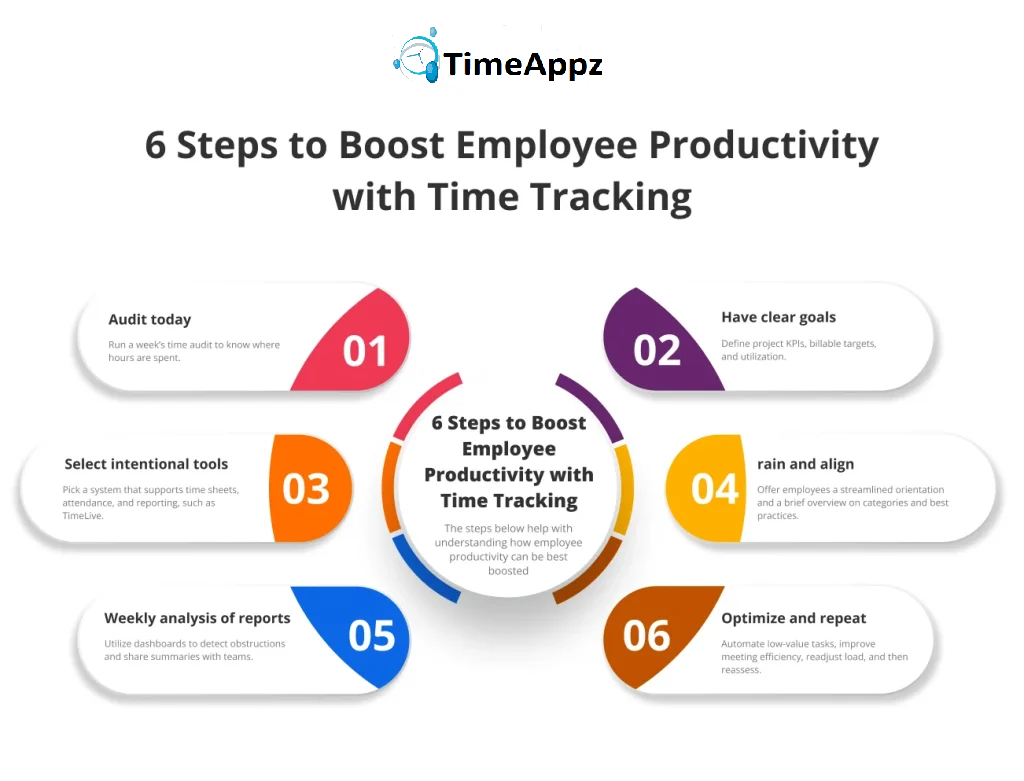
Implementation checklist (30–60 days)
- Run and check a two-week time audit.
- Define 3–5 key metrics (utilization, billable %, project variance).
- Select a suitable vendor and test the solution with one team.
- Publish a monitoring policy and hold Q&A.
- Train team leads and employees.
- Review reports after 30 days and implement small process changes.
- Reassess after 60 days and expand rollout.
Conclusion
Productivity measurement is compelling when it’s used to remove hurdles, not to punish employees.
The employee productivity monitoring software is the one that respects privacy, integrates rightly with HR and billing systems, and aims to improve the process. This will turn hidden inefficiencies into clear actions.
Stop guessing and start optimizing with ProjecTime by Timeappz. For a free workflow audit and tailored plan, contact our team at [email protected] or Live ChatThe Live Chat option is in the bottom-left corner!← Look Left to explore implementation options tailored to your construction operations.
Frequently Asked Questions
What is employee productivity monitoring software?
- It is a tool that informs how employees spend work hours across tasks and projects. This data helps managers identify inefficiencies and assign resources smartly.
- Yes. It provides real-time visibility for remote, hybrid, and on-site teams so that managers can track progress without intrusive supervision.
- If implemented ethically and transparently, it can improve clarity and fairness when used for training and process change.
- Yes. ProjecTime integrates with employee time off tracking software for smooth leave requests and accurate capacity planning.
- Definitely. It helps small teams and enterprises minimize manual admin while improving reporting and billing accuracy.
🎯 Put Your Timesheet Management on Complete Autopilot
Relying on manual human memory to construct administrative records leaves your organization exposed to severe revenue leakage, inaccurate client billing, and delayed payroll cycles. ProjecTime by TimeAppz eliminates the friction by bridging the gap between your team’s actual work stack and your financial ledger. Streamline your operations, satisfy audit oversight parameters, and run securely on our optimized cloud or deploy On-Premises behind private corporate networks.
Permanently Free Plan
Perfect for small teams or independent operators. Includes core timesheets, billing, and support for up to 2 users and 1 project permanently.
Advanced Automation Trial
Unlock our 30-Day Full-Feature Trial—no credit card required. Experience multi-layer calendar syncing, automated webhooks, custom approval gateways, and native Zapier integration.
Related Blogs
 DCAA Timekeeping Requirements: A Practical Guide for Government Contractors
If your organization holds a cost-reimbursable, time-and-materials, or labor-hour government contract
TimeAppz
 Timesheet Reminders: How to Ensure On-Time Submission Every Week
Late timesheet submissions are a management problem before they are an employee
TimeAppz
 Timesheet Approval Process: Best Practices for Teams
A timesheet without an approval is not a reviewed document. It is
TimeAppz